The HYROX Split That *Actually* Decides Your Finish Time
The HYROX Split That Actually Decides Your Finish Time
Ever found yourself in the finish chute, gasping for air, wondering where you could have shaved off those crucial minutes? Was it the sled push that destroyed your legs? Did you go too slow on the rower? Or maybe it was the wall balls? At every HYROX event, the post-race debrief revolves around one question: Where are races truly won and lost?
Most athletes point to the notoriously tough stations like the Sled Push or Burpee Broad Jumps. It feels intuitive—these are the moments of maximum struggle, the splits where we feel we're losing the most ground. But what if the data told a different story?

What if the single most decisive factor in your final ranking wasn't a specific exercise at all?
Tapping into our database of over 721,473 HYROX race results, we've conducted a deep-dive analysis to find the "kingmaker" split—the one part of the race that has the strongest relationship with your final placing. The answer is surprising, and it holds the key to unlocking your next PR.
Spoiler alert: This one variable often explains more than 75% of the variation in an athlete's final race position.
The Data-Driven Approach: Finding the "Kingmaker" Split
To move beyond gut feelings and anecdotes, we needed a robust statistical method. We chose to use rank-correlation analysis (specifically, Spearman's rank-correlation coefficient).
Don't worry, you don't need a degree in statistics to understand it. Here’s a simple breakdown:
- Ranking: For every athlete in a race, we looked at their rank for each individual split (e.g., 50th fastest Sled Push, 12th fastest Run 1) and their overall final rank (e.g., 32nd place overall).
- Correlation: We then measured the relationship between their rank in a specific split and their final overall rank.
This produces a correlation coefficient—a number between -1 and 1.
- A score of 1.0 would mean a perfect relationship. (e.g., The fastest person on the Sled Push finished 1st overall, the 2nd fastest finished 2nd, and so on, with no exceptions).
- A score of 0 would mean there's absolutely no relationship between performance on that split and the final outcome.
By calculating this for every split—including the total running time and the total time spent in the Roxzone—we can definitively see which parts of the race are most predictive of a high finish position.
The Most Influential Splits: A Surprising Leaderboard
After analyzing hundreds of thousands of results from the Open divisions, a clear picture emerges. While every station matters, two splits stand head and shoulders above the rest in determining your final rank.
And the one everyone suspects—the Sled Push? It’s important, but it’s not even in the top three.
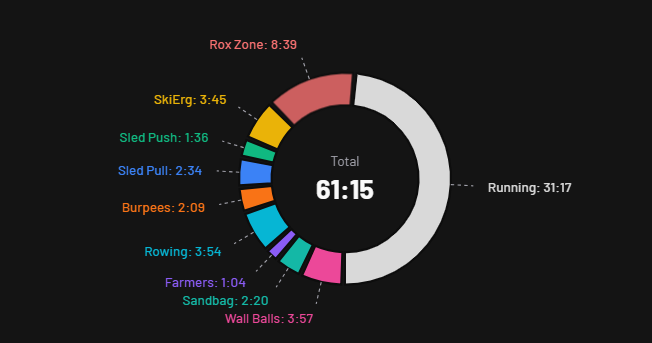
(This chart visualizes where athletes spend their time. Note how running and the Roxzone combine to make up a massive portion of the total race time.)
Here is the definitive ranking of which splits have the highest correlation with your final placing for HYROX Open athletes (both men and women).
Table: Split Correlation with Final Rank (Open Division)
| Split | Correlation Coefficient | Decisiveness |
|---|---|---|
| Total Run Time | 0.94 | Extremely High |
| Total Roxzone Time | 0.87 | Very High |
| Sandbag Lunges | 0.81 | High |
| Burpee Broad Jumps | 0.78 | High |
| Wall Balls | 0.74 | Significant |
| Sled Push | 0.72 | Significant |
| Sled Pull | 0.70 | Significant |
| Farmer's Carry | 0.68 | Moderate |
| Rower | 0.65 | Moderate |
| SkiErg | 0.64 | Moderate |
Key Insights from the Data:
-
Running is King: With a staggering correlation of 0.94, your total run time is, by far, the most powerful predictor of your final place. This isn't groundbreaking, as running makes up roughly 50% of the total race time. If you want to be competitive, you simply must be a proficient runner. There's no way around it.
-
The Roxzone is the Kingmaker: This is the big surprise. Your total time spent in the Roxzone—the transitions between running and stations—is the second most important factor in your race. With a correlation of 0.87, it’s more influential than any individual strength station. The Roxzone represents your ability to recover, transition efficiently, and handle the "compromised" state of HYROX. It's the ultimate test of true fitness, and it’s where countless athletes unknowingly give up minutes.
-
The Grind Stations: The Sandbag Lunges and Burpee Broad Jumps rank third and fourth. This makes sense. They are full-body, high-fatigue movements that occur late in the race. Performing well here signifies excellent strength endurance and pacing. A poor performance doesn't just mean a slow split; it means a destroyed heart rate, slow recovery (longer Roxzone), and a crippled final run.
Pro vs. Open: Do the Elites Play a Different Game?
The data gets even more interesting when we segment the population. Are the factors that decide a race the same for a top-50 Pro as they are for a first-timer?
Yes and no. While the top splits remain the same, their relative importance shifts, highlighting the razor-thin margins at the elite level.
Table: Split Correlation with Final Rank (Pro vs. Open Men)
| Split | Pro Correlation | Open Correlation | Key Difference |
|---|---|---|---|
| Total Run Time | 0.95 | 0.94 | Consistently #1 |
| Total Roxzone Time | 0.91 | 0.87 | More crucial for Pros |
| Sandbag Lunges | 0.84 | 0.81 | More crucial for Pros |
| Burpee Broad Jumps | 0.82 | 0.78 | More crucial for Pros |
| Wall Balls | 0.75 | 0.74 | Roughly Equal |
| Sled Push | 0.68 | 0.72 | Less decisive for Pros |
| Sled Pull | 0.66 | 0.70 | Less decisive for Pros |
Analysis:
For the Pro athletes, the correlation of the Roxzone jumps from 0.87 to 0.91. This is a massive indicator. At the elite level, every athlete is strong. Every athlete can run fast (in isolation). The race is won and lost in the transitions. The ability to recover from a max-effort station and immediately settle into a fast run pace is the game.
Conversely, the correlation for the Sleds actually decreases for the Pros. Why? Because all Pro athletes have reached a baseline level of strength where they can move the sleds efficiently. It's no longer a major point of separation. For the Open division, however, an athlete might be completely stopped by a sled, making it a more impactful (and variable) split for the general population.
Turning Data into Medals: How to Improve Your Key Splits
This analysis is fascinating, but it's useless if you can't apply it. Here’s how to translate these findings into a faster finish time.
1. Become a HYROX Runner, Not Just a Runner
Your 10k PR on fresh legs means very little after pulling a 125kg sled. Your training must reflect the demands of the race.
- Actionable Tip: Implement compromised running sessions weekly. A classic workout is 8 rounds of: 800m run at your target race pace, followed immediately by 20 heavy kettlebell swings or 15 burpees. The goal is to teach your body to clear lactate and find your stride under duress.
2. Conquer the Roxzone: Your New Favorite Discipline
Stop thinking of the Roxzone as "rest." It's an active part of the race. Every second wasted here is a second you can never get back. Our data shows that top athletes are not just faster in the stations; they are disproportionately faster in the transitions.
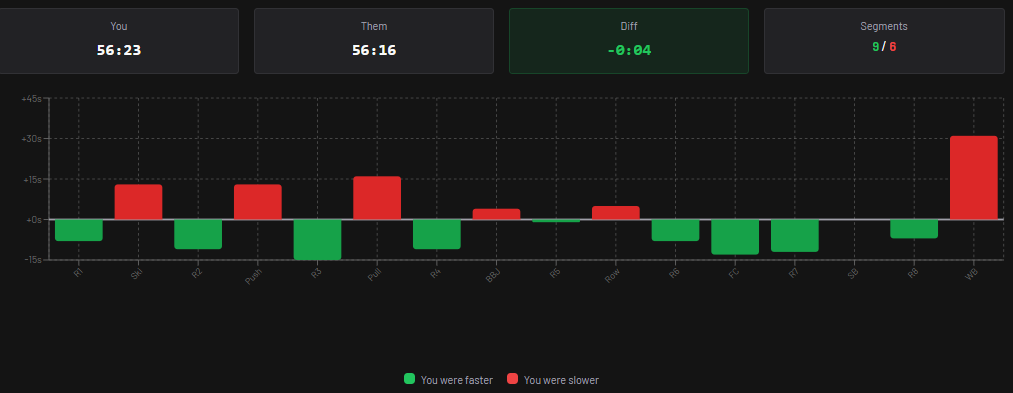
(This graph illustrates how time gained or lost vs the race leader, a useful analysis to really breakdown your race consistency.)
- Actionable Tip 1: Practice Transitions. Set up a mini-circuit in your gym: 400m on the treadmill -> 30 seconds of Farmer's Carries -> 400m on the treadmill. Time the entire block, including how long it takes you to get off the treadmill, pick up the kettlebells, start, and then get back on the treadmill. Shave those seconds down.
- Actionable Tip 2: Pacing for Recovery. The reason your Roxzone time is high is often because you red-lined on the preceding station. Go into the Sled Push at 95% effort instead of 105%. You might lose 5 seconds on the sled, but if you save 30 seconds in the Roxzone and run the next 1k 20 seconds faster, you're looking at a massive net gain of 45 seconds.
3. Build a Resilient Engine
While the Lunges and Burpees ranked below the Roxzone, they are intrinsically linked. A failure here causes your Roxzone time to balloon and your run to crumble.
- Actionable Tip: Focus on strength endurance workouts that mimic the end-of-race fatigue. For example: a 20-minute AMRAP (As Many Rounds As Possible) of: 10 calories on the SkiErg, 15 Wall Balls, and 20 Alternating Lunges. This builds the capacity to keep moving under extreme metabolic stress, directly improving your performance on these key stations and protecting your Roxzone and run times.
The Secret Is Out: It's All About the Flow
For years, athletes have focused on isolated metrics: your fastest 1k run, your heaviest sled push. But HYROX isn't a series of isolated events. It's a continuous, flowing test of fitness, and the data proves that the "in-between" moments are what separate good from great.
Running is the foundation upon which your race is built. But the Roxzone is the mortar that holds it all together.
Stop training stations in isolation and start training the flow of the race. Practice your transitions, master your pacing, and build an engine that recovers in seconds, not minutes. That’s where you’ll find not just your next PR, but a whole new level of performance.
Written by
Comments